Published 25 October 2026
A day at Didyma, Miletus and Priene takes you south of Kusadasi to three important ancient sites on the Aegean coast. Each has its own character: a hillside Hellenistic town, a great harbour city and a vast temple where people once came to consult an oracle. Here is what the day looks like, the order we suggest and what to bring.
Why visit these three sites together
The three sites sit close to each other along the old Maeander river plain, so they fit comfortably into one day.
Historically they belong together too. Miletus was the leading city of the region, Didyma was its sanctuary, and Priene was its smaller neighbour across a bay that has since become land.
They are also generally quieter than Ephesus. That makes this a good choice if you have already seen Ephesus or prefer a calmer day among the ruins. If you are still deciding how to divide your time in the area, see our guide to Kusadasi in 1, 2 or 3 days.
The suggested order
We usually recommend this route:
- Priene in the morning (about 1–1.5 hours)
- Miletus around the middle of the day (about 1–1.5 hours)
- Didyma in the afternoon (about 1–1.5 hours), then back to Kusadasi
Priene is the closest of the three to Kusadasi. Its hillside setting means some uphill walking, which is easier while the morning is still cool.
Miletus is mostly flat and sits between the other two. Didyma is the furthest south, so finishing there makes for a logical drive back.
The modern town of Didim around the temple has cafés and restaurants, so Didyma is a convenient place for a late lunch or a drink before the drive back.
Plan on a full day, including the driving time between the sites. If you have a particular interest or a time limit, mention it when you book.
Priene: a Hellenistic town on a mountainside
Priene sits on terraces below the cliffs of Mount Mycale, looking out over the flat plain that was once the sea. Even if you are not especially interested in archaeology, the setting alone makes the visit worthwhile.
What to see
- The grid plan. Priene was laid out in the 4th century BC on a regular grid of streets. You can clearly see how the town was organised into blocks of houses, public buildings and squares, all fitted onto a slope.
- The Temple of Athena. A few of its Ionic columns have been put back up and stand against the mountain behind. An inscription recording Alexander the Great’s dedication of the temple is now in the British Museum.
- The theatre. It is small and well preserved, with carved marble seats of honour in the front row.
- The bouleuterion (council house). It has neat rows of stone seating and is one of the most complete buildings on the site.
Practical point: the path from the entrance climbs steadily and the ground is uneven. Wear proper walking shoes and carry water.
Miletus: theatre, philosophers and a lost harbour
Miletus was once a leading city of the Greek world, with harbours that opened onto the sea. Today it stands well inland.
Over the centuries the Maeander river (Büyük Menderes) carried silt into the bay until the harbours filled up and the coastline moved away.
What to see
- The great theatre. This is the highlight and the first thing you see as you arrive. From the top rows you can look out over the plain where ships once anchored.
- The harbour area and the city behind it. Paths lead past the remains of the harbour, baths and public buildings. Parts of the low-lying area can be marshy, depending on the season.
- İlyas Bey Mosque. This 15th-century mosque stands among the ancient ruins and is a peaceful spot.
Why Miletus matters
Miletus is known as the birthplace of Thales, often described as the first Greek philosopher, and of other early thinkers such as Anaximander.
The town planner Hippodamus also came from Miletus. His name is linked with the grid layout you will have just seen at Priene.
Didyma: the Temple of Apollo
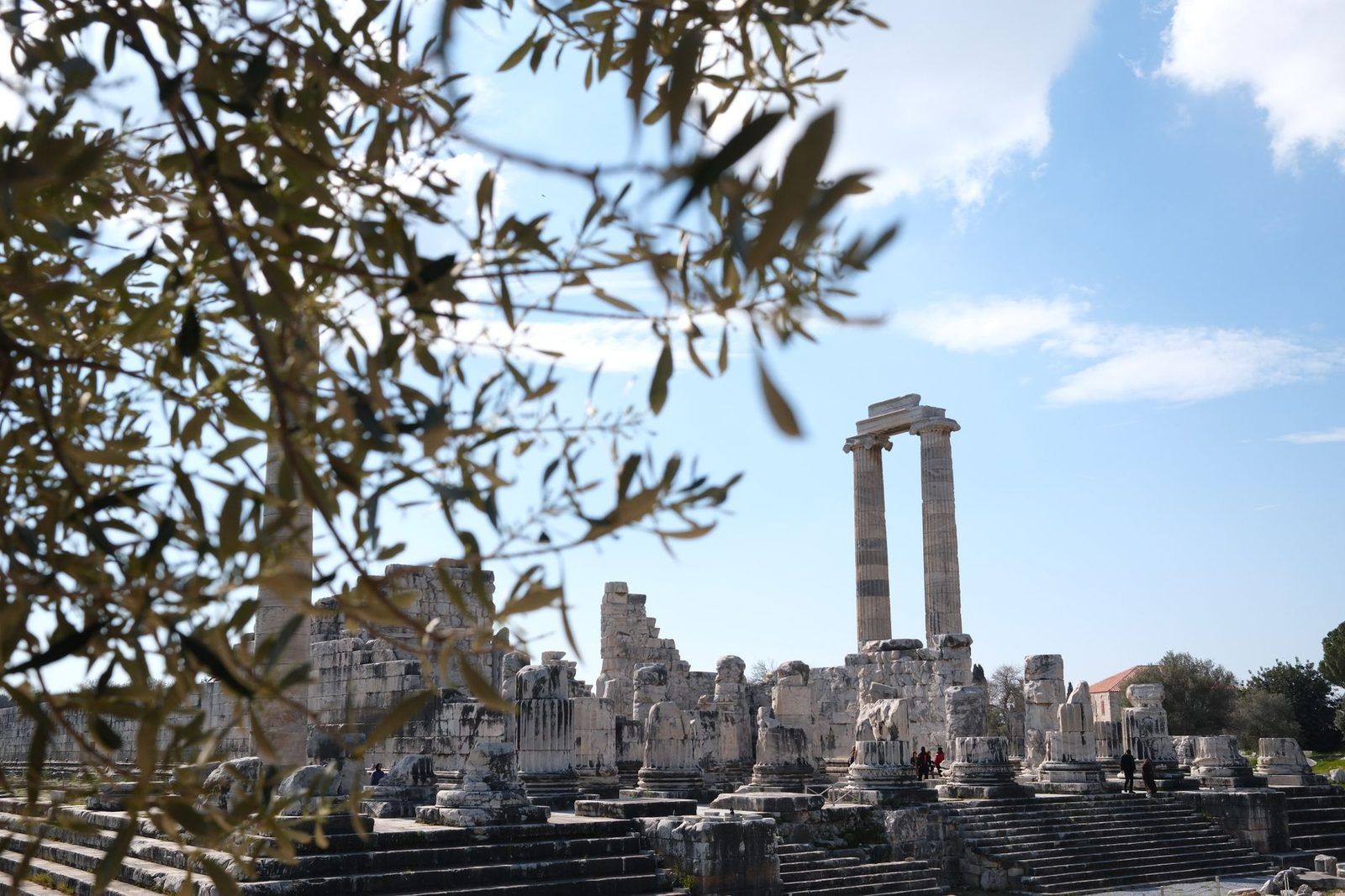
Didyma was not a city but a sanctuary, home to a famous oracle of Apollo that was connected to Miletus by a sacred road. The temple you see today is the great Hellenistic rebuilding, which was never fully completed. It stands in the middle of the modern town of Didim.
What to see
- The columns. The scale is the first thing that strikes you. The surviving columns are close to 20 metres tall, and their bases are carved in fine detail.
- The inner court. Ordinary visitors did not enter the inner court (adyton). Today you can look down into it, where the sacred spring and a small shrine once stood.
- The Medusa head. This large carved head of Medusa once decorated the temple’s frieze. It now rests near the temple and is a popular spot for photographs.
- Unfinished details. Some column drums and walls were never smoothed. They show how the builders worked.
How the day works with us
This is a private round trip in a car with a driver. We pick you up from your Kusadasi hotel or from Kusadasi cruise port. At each site the driver waits while you visit.
- One price per vehicle: for up to 8 passengers. A larger group gets a second vehicle.
- Transfer only: a guide and entrance tickets are not included.
- Free cancellation: up to 24 hours before your trip.
- Payment: in cash or by card.
Opening hours change, so check them before your visit. You can buy entry tickets on our museum tickets page.
Advice for cruise passengers
This route needs most of the day. If your all-aboard time leaves you less than a full day ashore, keep to Ephesus only.
Look up your time in port first on our Kusadasi cruise ship schedule. Our cruise day planner can help you decide whether this route or Ephesus suits your day better.
What to bring
- Comfortable shoes with good grip
- Hat, sunglasses and sun cream, because there is little shade at any of the three sites
- Water, especially in summer
- A light layer in spring and autumn, when it can be windy on Priene’s hillside
- Some cash or a card for entry and refreshments
Tickets
You can buy entry tickets for Didyma, Miletus and Priene, which are state archaeological sites, on our museum tickets page for today or up to 7 days ahead. Payment is by card, and your ticket (barcode) is sent to you on WhatsApp. Each visitor needs to provide their full name, passport number and nationality. We are an independent seller, not the official ministry website, and tickets cannot be refunded once purchased.
Frequently asked questions
Can I do Ephesus and these three sites on the same day?
No, we do not recommend it. Each trip deserves a full day. If you want to see Ephesus, our private car to Ephesus is a separate round trip. You walk downhill from the Upper Gate to the Lower Gate, where your driver waits. For cruise passengers, see how to get from Kusadasi cruise port to Ephesus.
Is this day tiring?
Moderately. There is a fair amount of walking, with the most climbing at Priene. Miletus and Didyma are mostly flat. Because the driver waits, you can rest whenever you need to.
Is a guide included?
No. This is a transfer only, so a guide and entrance tickets are not included. You can explore the sites on your own, perhaps with a guidebook.
Which site is the highlight?
There is no single highlight; it depends on your interests. Didyma has the most dramatic scale, Miletus has the great theatre, and Priene has the most beautiful setting.
Is this trip suitable for cruise passengers?
Yes, if your ship is in port for most of the day. We pick you up at Kusadasi cruise port. If your all-aboard time leaves you less than a full day ashore, choose Ephesus instead.
Ready to plan your day? See the details and book your Didyma, Miletus and Priene private round trip from Kusadasi.