Published 25 October 2026
Most people come to Ephesus for the Library of Celsus and the Great Theatre, then head straight back to Kusadasi. Just a few minutes away, the town of Selçuk holds a quieter set of sights: a great Byzantine basilica, a hilltop castle and a 14th-century mosque. Here is what you can see in Selçuk and how to fit it into an Ephesus day without a rush.
Why Selçuk matters to the Ephesus story
Ephesus did not simply disappear. As the harbour silted up and the old city declined, life gradually moved to Ayasuluk Hill, the hill above modern Selçuk. Christians, Byzantines, Turkish emirs and Ottomans all left their mark there.
A visit to Selçuk is not a detour away from Ephesus. It is the next chapter of the same story. Seeing the ancient city first and then the hill gives you a clearer picture of how the area changed over the centuries.
The Basilica of St. John
A church built over a traditional tomb
According to early Christian tradition, John the Apostle spent his final years in Ephesus and was buried on Ayasuluk Hill. A smaller church first stood over the site. In the 6th century, the Byzantine emperor Justinian replaced it with a large domed basilica, among the largest churches in the region at the time.
Historians still debate the details of John’s life in Ephesus. Even so, the tradition has drawn pilgrims to the hill for well over a thousand years. Today you can see the marked spot of the traditional tomb near the centre of the church.
What you see today
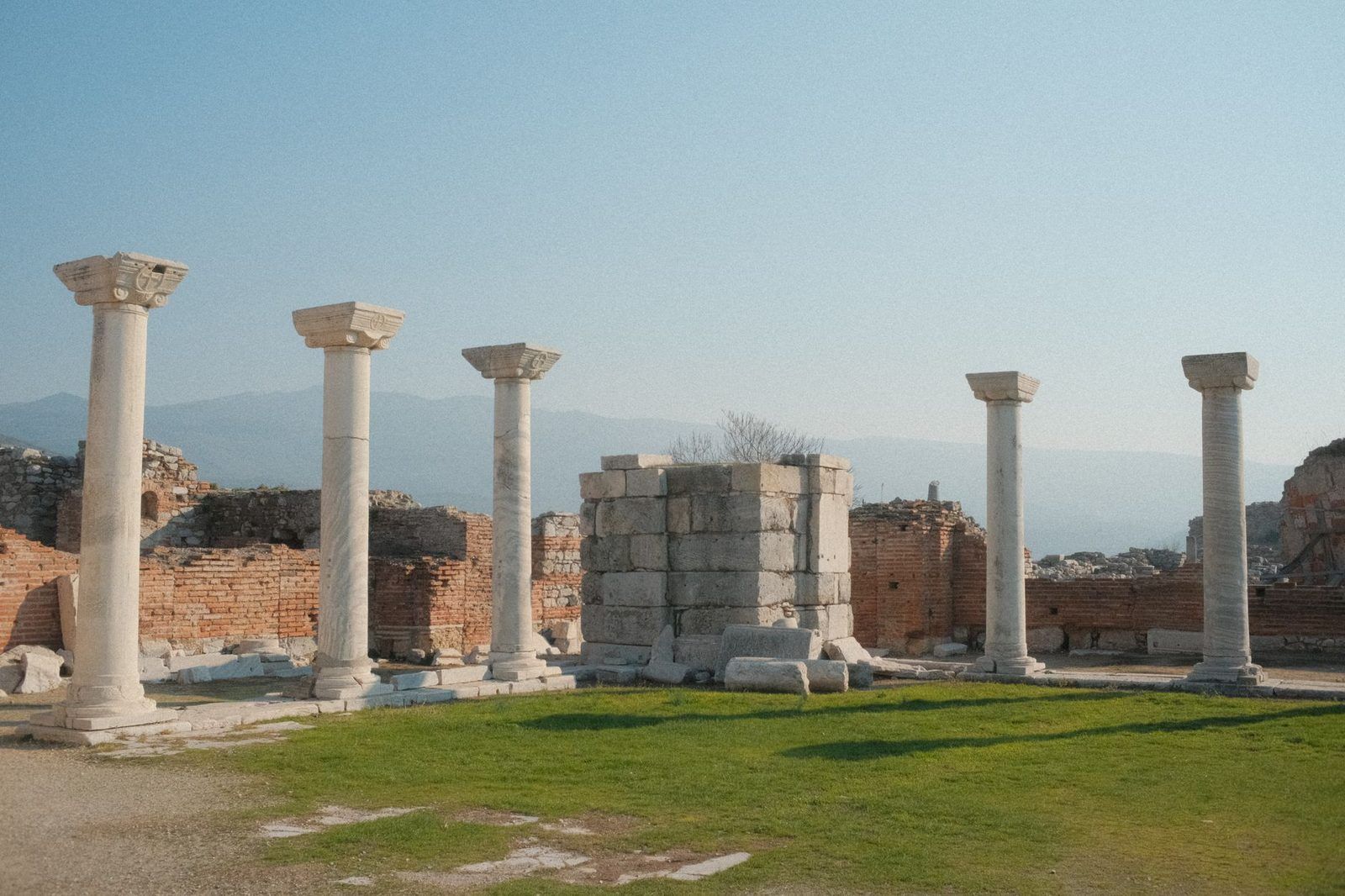
Earthquakes and centuries of neglect brought the basilica down, but parts of it have been carefully restored. Highlights include:
- The Gate of Persecution: the fortified gateway you walk through on the way up the hill
- The marble columns: re-erected columns that give a sense of the church’s scale
- The traditional tomb of St. John: inside the area of the former main altar
- The baptistery: a small structure next to the main church
- The views: wide views over Selçuk, the İsa Bey Mosque and the plain towards the site of the Temple of Artemis
The basilica is usually quieter than the main site at Ephesus.
Practical point: the ground is uneven and there is little shade, so bring water and a hat in the warmer months.
Ayasuluk Castle
Above the basilica stands Ayasuluk Castle, a fortress whose walls date mainly from the Byzantine and later Turkish periods. The hill gives a wide view across the town and the valley towards Ephesus.
Access to the castle has varied over the years. Check the official museum website before your visit for the current situation.
Even when the castle is closed, the walls look striking from the basilica grounds and photograph well from below.
İsa Bey Mosque
At the foot of Ayasuluk Hill is the İsa Bey Mosque. It was built in the 14th century under the Aydınoğulları, a Turkish emirate that controlled this region before the Ottomans. It is one of the finest early Turkish mosques in Anatolia.
Look out for:
- The western façade: tall, with carved marble decoration
- The reused ancient columns: in the courtyard and prayer hall, a reminder of how much older material was taken from nearby ruins
- The courtyard: once laid out differently, now holding surviving column bases and fragments
The İsa Bey Mosque is a place of worship, so please dress respectfully. Cover shoulders and knees, and women should bring a scarf for their hair.
Visitors are usually asked to wait outside during prayer times.
Selçuk town
Selçuk itself is a small, friendly market town. It is easy to walk around, with tea gardens, simple local restaurants and shops selling everyday goods as well as souvenirs.
In the centre, you will notice the remains of a Byzantine aqueduct running along the street. In spring and summer, storks often nest on top of the arches.
Two more Selçuk sights worth knowing
The Temple of Artemis
The Temple of Artemis was once one of the Seven Wonders of the Ancient World. Today the site is marked by a single reconstructed column standing in a marshy field. It takes imagination, but the site is still worth a short stop. Read our full guide to the Temple of Artemis for its history and what to expect.
The Ephesus Museum
Many important finds from Ephesus are not at the ancient site but in the museum in Selçuk, including well-known statues of Artemis. If you want to see the objects that once filled the city’s houses and temples, read our Ephesus Museum guide.
How to fit Selçuk into your Ephesus day
With our private car with driver to Ephesus, the Selçuk sights are optional free stops in every Ephesus package. Tell your driver which ones you would like to see.
Suggested order and timing
After Ephesus, this order works well with little backtracking:
- Temple of Artemis: about 15–20 minutes
- Basilica of St. John: about 30–45 minutes
- İsa Bey Mosque: about 15–20 minutes
- Ephesus Museum: about 1 hour
All four take roughly two and a half hours including short drives. You can pick just one or two.
How the day runs
- We pick you up from your Kusadasi hotel or the Kusadasi cruise port.
- If your package includes it, we visit the House of the Virgin Mary first (about 30–60 minutes).
- The driver drops you at the Upper Gate of Ephesus, and you walk down through the ancient city (about 1.5 km, 2–3 hours at an easy pace).
- The driver waits for you at the Lower Gate.
- From there, Selçuk is a short drive, and you add the stops you have chosen.
- If your package includes Şirince, the village comes next (about 1–1.5 hours). Selçuk is on the way.
- We drive you back to Kusadasi.
Please note: our trips are transfer only. A guide and entrance tickets are not included. Entry arrangements and opening hours change, so check opening hours before your visit. You can buy entry tickets on our museum tickets page.
Arriving by cruise ship
If your all-aboard time leaves you less than about six hours ashore, keep to Ephesus only. With more time, one or two Selçuk stops fit comfortably. Check your ship’s times on our Kusadasi cruise ship schedule and see our cruise day planner. For the journey itself, read how to get from Kusadasi cruise port to Ephesus.
If you are staying longer, our guide to Kusadasi in 1, 2 or 3 days shows how Selçuk fits into a wider plan.
Tickets
You can buy entry tickets for the Basilica of St. John, the Ephesus Museum and Ephesus on our museum tickets page for today or up to 7 days ahead. Payment is by card, and your ticket (barcode) is sent to you on WhatsApp. Each visitor needs to provide their full name, passport number and nationality. Please note that we are an independent seller, not the official ministry website, and tickets cannot be refunded once purchased.
Frequently asked questions
Is the Basilica of St. John worth visiting if I have already seen Ephesus?
Yes, especially if you are interested in early Christianity or Byzantine history. It shows a later chapter of Ephesus, it is usually quieter than the main site, and the views from the hill are wide.
How do I check entry and opening hours for the basilica?
You can buy entry tickets on our museum tickets page. Entry arrangements and opening hours change, so we do not list them here.
How much time should I allow for Selçuk?
Allow about 30–45 minutes for the Basilica of St. John and 15–20 minutes for the İsa Bey Mosque. Add 15–20 minutes for the Temple of Artemis and about an hour for the Ephesus Museum if you include them.
Can I add Selçuk stops to any Ephesus package?
Yes. The İsa Bey Mosque, Basilica of St. John, Temple of Artemis and Ephesus Museum are optional free stops in all our Ephesus packages. These include Ephesus only, Ephesus with the House of the Virgin Mary, and Ephesus with the House of the Virgin Mary and Şirince.
How many people can travel in one car?
Up to 8 passengers travel in one vehicle, and the price is per vehicle, not per person. A larger group gets a second vehicle.
If you would like to see Selçuk’s quieter side along with the ancient city, book our private Ephesus transfer from Kusadasi and tell us which stops you would like. Free cancellation is available up to 24 hours before, and you can pay in cash or by card.