Published 25 October 2026
Ephesus can feel overwhelming the first time you walk through the gate. There is marble in every direction and very little signage to tell you what you are looking at. This guide follows the classic downhill route from the Upper Gate to the Lower Gate, so you know what to look for and in what order.
Why walk from the Upper Gate down
Ephesus sits on a slope between two hills. The main street runs downhill from the Upper (Magnesian) Gate towards the Library of Celsus and the Great Theatre. Starting at the top means you walk downhill the whole way, about 1.5 km, and finish near the theatre at the Lower Gate.
This is exactly how our private Ephesus transfer works. The driver drops you at the Upper Gate, you walk through the ancient city at your own pace, and the driver waits for you at the Lower Gate. If you are arriving by ship, our guide on how to get from Kusadasi cruise port to Ephesus explains the options.
Opening hours change, so check them before your visit. For entry tickets, see our museum tickets page.
The upper city: the civic heart
State Agora
Soon after the Upper Gate you pass a large open space on your left. This was the State Agora, the political and administrative centre of the Roman city. Officials met and public business was carried out here, unlike the commercial agora further down.
Much of it is now a grassy field with scattered column bases. It helps to imagine it lined with long colonnades.
Odeon
Just beyond the agora is the Odeon, a small, steep theatre that is easy to recognise. It dates from the 2nd century AD and is thought to have served as a meeting place for the city council (the bouleuterion) as well as for concerts and recitals. Climb a few rows for a good view back over the agora.
Prytaneion, the Gate of Hercules and the Nike relief
Next to the Odeon are the remains of the Prytaneion, a civic building where the sacred flame of the city was kept.
As the road starts to drop, look out for the Memmius Monument and the Gate of Hercules, which has two reliefs of Hercules wearing a lion skin. A relief of Nike, the winged goddess of victory, is displayed nearby and is one of the most photographed carvings in Ephesus.
Curetes Street: the main descent
From the Gate of Hercules, Curetes Street runs downhill towards the library. Its name comes from the Curetes, a group of priests linked to the city’s religious life. This stretch has marble paving, columns, statue bases and shop fronts on both sides.
Along the way you will see:
- The Fountain of Trajan, a monumental fountain dedicated to the emperor Trajan, now partly reconstructed
- Statue bases with inscriptions honouring wealthy citizens who paid for public buildings
- Glimpses of the Library of Celsus at the bottom of the street, a good photo as you approach
Temple of Hadrian
On the right side of Curetes Street is the Temple of Hadrian, a small but finely decorated temple dedicated to the emperor Hadrian in the 2nd century AD. Look at the arched front and the carved figure in the arch above the doorway. Some of the reliefs on site are copies; the originals are kept in the Ephesus Museum in Selçuk.
The latrines
Behind the Temple of Hadrian are the public latrines. Long rows of marble seats with keyhole openings line the walls, and a water channel once ran beneath them. These toilets were communal, and in Roman times they were also a place to talk. It is a quick visit and worth the short detour.
Terrace Houses
On your left, opposite the Temple of Hadrian and under a large modern roof, are the Terrace Houses. These were homes of wealthy Ephesians, with wall paintings, mosaics and marble floors still in place. The walkways inside are steep in places, so allow extra time. Our Terrace Houses guide covers what to see inside.
The Library of Celsus
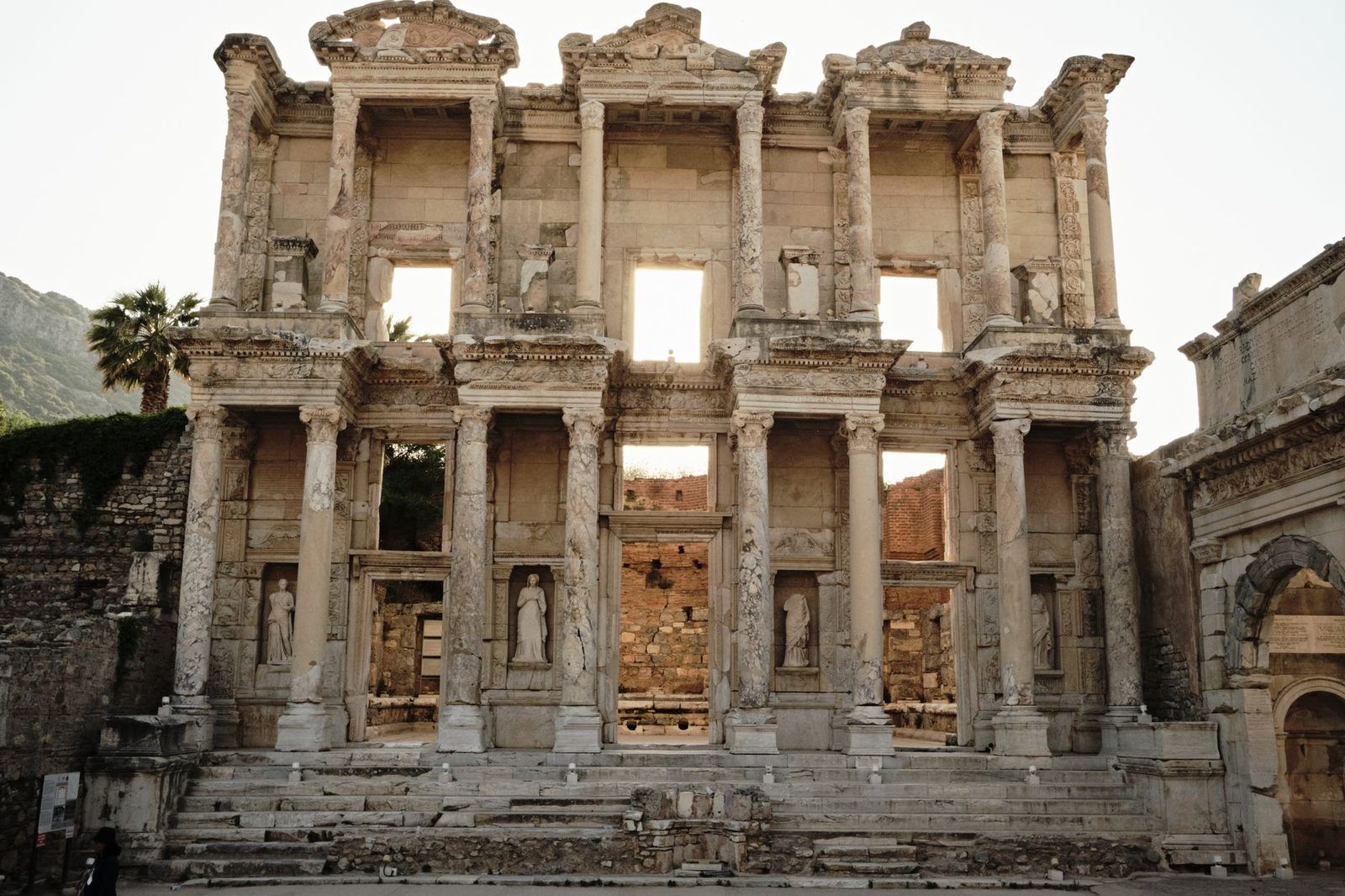
At the bottom of Curetes Street you reach the Library of Celsus, the image most people have in mind when they think of Ephesus. It was built in the early 2nd century AD by Gaius Julius Aquila in memory of his father, Tiberius Julius Celsus Polemaeanus, a Roman senator and governor. Celsus was buried in a tomb beneath the building, which was unusual for a library.
The two-storey façade you see today was re-erected by archaeologists in the 1970s using original pieces. Look for the four statues in the niches. They represent Wisdom, Knowledge, Intelligence and Virtue, and the ones on site are copies.
Beside the library is the Gate of Mazaeus and Mithridates, built by two freed slaves in honour of the emperor Augustus and his family. It leads into the Commercial (Lower) Agora, once the city’s main marketplace.
Tip: the library square is the busiest spot in Ephesus. An early start helps if you want photos without crowds. Our guide on when to visit Ephesus explains the quieter times of day and year.
Marble Street and the Great Theatre
Marble Street
From the library, turn right onto Marble Street, which runs north alongside the Commercial Agora towards the theatre. It is paved with large marble slabs, and you can still see grooves worn by wheels.
The Great Theatre
The Great Theatre is built into the slope of Mount Panayır and is the largest structure you will see on this walk. It was enlarged under the Romans and used for performances, public gatherings and gladiator and animal fights in the Roman period.
The theatre is also linked to the story of St Paul. The Acts of the Apostles describes a riot here, started by silversmiths who made shrines of Artemis and feared his preaching would harm their trade. Some areas may be closed for restoration, but you can usually climb part of the seating for a wide view.
Harbour Street
From the theatre, look west along Harbour Street (also called the Arcadian Way). This colonnaded avenue once led straight to the harbour. Over the centuries the river silted up the harbour, and the sea is now several kilometres away. This change in the coastline is one of the main reasons the city declined.
The Lower Gate
The Lower Gate, where our driver meets you, is a short walk from the theatre.
Practical tips for the walk
How long does it take?
Allow 2–3 hours at an easy pace for the main route. Add extra time if you visit the Terrace Houses or like to stop often for photos.
Short on time?
If you only have a short visit, keep to these highlights, still walking downhill:
- The Odeon
- The Temple of Hadrian
- The Library of Celsus
- The Great Theatre
Shoes
The marble paving is uneven and can be slippery where centuries of feet have polished it smooth. Wear comfortable, closed walking shoes with good grip. Flip-flops and smooth soles are a bad idea.
Heat and water
Ephesus has very little shade, and the marble reflects heat. From late spring to early autumn it can get very hot by late morning.
- Water: bring more than you think you need
- Sun protection: wear a hat, sunglasses and sun cream
- Timing: start early, or go later in the afternoon in summer
Cruise passengers
If your all-aboard time leaves you less than about six hours ashore, keep to Ephesus only. Check your ship’s times on our Kusadasi cruise ship schedule or read our page for cruise passengers.
Adding other sites
Our Ephesus packages can include the House of the Virgin Mary and Şirince. The route is:
- Kusadasi
- House of the Virgin Mary (30–60 minutes)
- Ephesus, from the Upper Gate down to the Lower Gate (2–3 hours)
- Şirince, if in your package (1–1.5 hours)
- Back to Kusadasi
Optional free stops in and around Selçuk fit in after the Lower Gate. A suggested order is the Temple of Artemis (15–20 minutes), the Basilica of St. John (30–45 minutes), the İsa Bey Mosque (15–20 minutes) and the Ephesus Museum (about 1 hour). For ideas on spreading sites over several days, see Kusadasi in 1, 2 or 3 days.
Tickets
You can buy entry tickets for Ephesus and the Terrace Houses on our museum tickets page for today or up to 7 days ahead. The Terrace Houses have their own ticket, separate from the main site, so choose both if you want to see both. Payment is by card, and your ticket with its barcode is sent to you on WhatsApp. Each visitor needs to provide their full name, passport number and nationality. We are an independent seller, not the official ministry website, and tickets cannot be refunded once purchased.
Frequently asked questions
Can I walk the route in the opposite direction?
Yes, but it is uphill all the way and harder in the heat. The top-to-bottom route is easier on the legs.
Do I need a guide?
No, you can walk the route on your own using a guide like this one. A licensed guide adds stories and context. Our transfers do not include a guide or entrance tickets.
Are the Terrace Houses worth the extra time?
Yes, if you enjoy mosaics, wall paintings and everyday Roman life.
Is the walk suitable for children or older visitors?
Yes, with care. The route is downhill and not physically difficult, but the surface is uneven and there is little shade. Go slowly, take breaks and carry water.
Can I add other sites on the same day?
Yes. Our packages can include the House of the Virgin Mary and Şirince, and optional free stops are available at the Temple of Artemis, the Basilica of St. John, the İsa Bey Mosque and the Ephesus Museum. See the suggested order above.
If you would like to walk Ephesus the easy way, downhill with a driver waiting at the bottom, have a look at our Kusadasi to Ephesus private transfer. We pick you up from your hotel or the cruise port in a private car with driver, at one price per vehicle for up to 8 people. You can pay by cash or card and cancel free of charge up to 24 hours before.